DESCRIPTION:
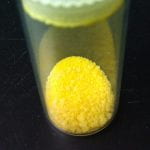
A reaction between two white solids occurs when lead nitrate and potassium iodide are shaken forcefully producing a mixture of yellow and white solid products. The reaction occurs almost instantaneously when aqueous solutions of these compounds are mixed, precipitating yellow lead iodide.
Pb(NO3)2 + 2KI → PbI2 + 2KNO3
In solution ions are more available and more likely to collide and thus react faster than they do in the solid state.
TOPICS COVERED:
– chemical change
– color change
– double replacement reactions
– mechanochemical reactions
– Law of Conservation of Mass
– precipitate reactions
– kinetics
MATERIALS NEEDED:
– small vial
– solid Pb(NO3)2
– solid KI
– test tube
– water
– 1 M Pb(NO3)2
– 1 M KI
PROCEDURE:
Solid Phase Reaction:
1. Combine equal masses of Pb(NO3)2 and KI in the vial
2. Shake forcefully until a bright yellow
Solution Reaction
1. Add ~1mL of water to the test tube
2. Add 2 drops of 1 M Pb(NO3)2 to the test tube
3. Add 4 drops of 1 M KI to the test tube
ADDITIONAL COMMENTS:
Using equal masses of each reactant for the solid-phase reaction works out stoichiometically because the molar masses of Pb(NO3)2 is approximately twice that of KI.
SAFETY:
Lead compounds are toxic to humans and the environment and thus should be disposed of properly. Safety goggles and gloves should be worn at all times, and care should be taken to avoid exposure.
REFERENCES:
“A Solid-Solid Reaction.” Nuffield Foundation. Accessed 17 June 2013 http://www.nuffieldfoundation.org/practical-chemistry/solid-solid-reaction
Shakhashiri, B.Z. Chemical Demonstrations; University of Wisconsin Press: Madison, 1983; Vol. 1, pp 85.