
• Log In
The Democracy Docket
  • HOME
  • 2019
  • 2020
  • 2021
  • 2023
  • 2024
  • Global Democracy Challenges
  • Privacy
Select Page

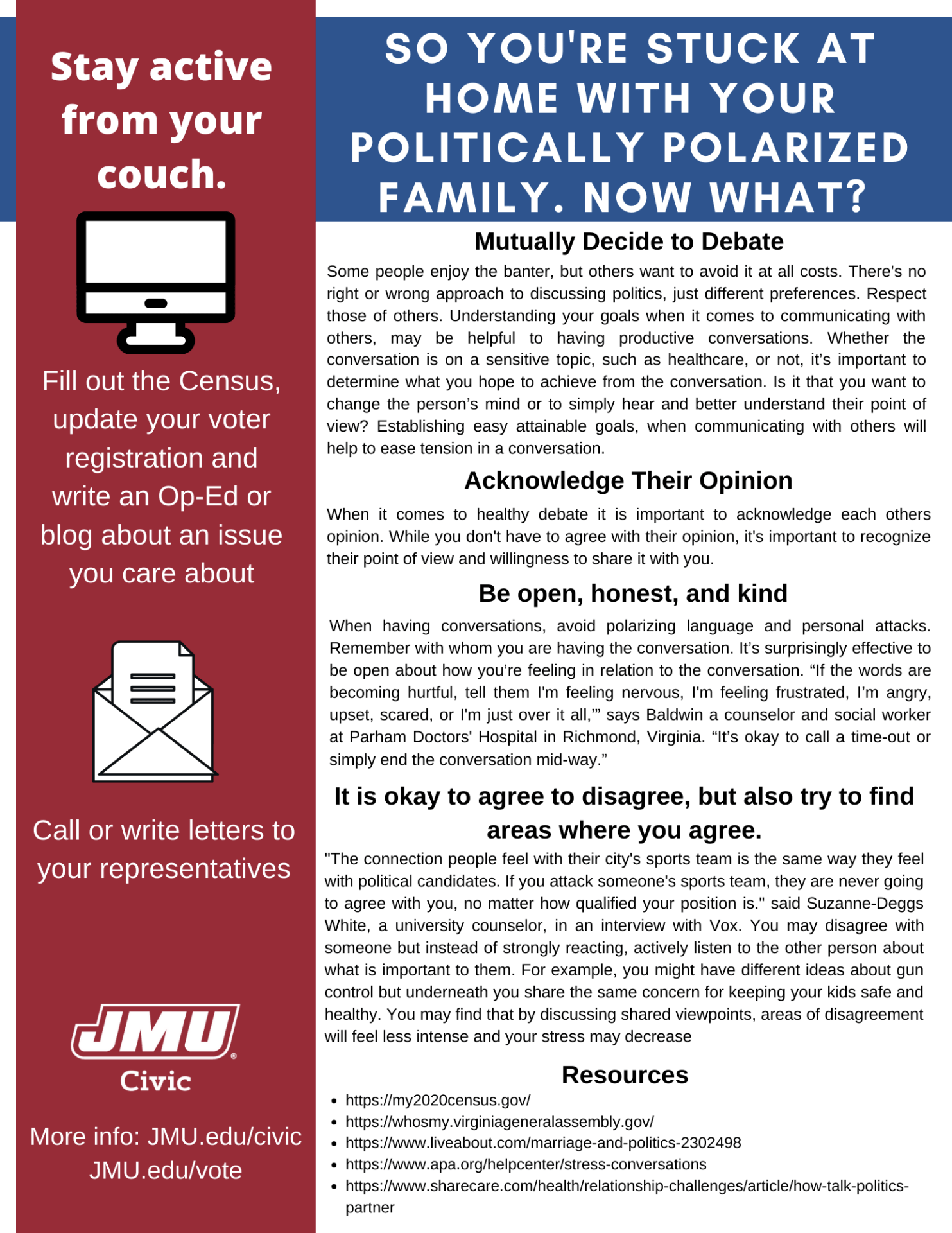
So you’re stuck at home with your politically polarized family. Now what?

Mar 19, 2020 | 2020, Civic Learning and Democratic Engagement | 0 comments

Post by Sarah Gully, JMU Civic Graduate Assistant

Mutually Decide to Debate

Some people enjoy the banter, but others want to avoid it at all costs. There’s no right or wrong approach to discussing politics, just different preferences. Respect those of others. Understanding your goals when it comes to communicating with others, may be helpful to having productive conversations. Whether the conversation is on a sensitive topic, such as healthcare, or not, it’s important to determine what you hope to achieve from the conversation. Is it that you want to change the person’s mind or to simply hear and better understand their point of view? Establishing easy attainable goals, when communicating with others will help to ease tension in a conversation.

Acknowledge Their Opinion

When it comes to healthy debate it is important to acknowledge each others opinion. While you don’t have to agree with their opinion, it’s important to recognize their point of view and willingness to share it with you.

Be open, honest, and kind

When having conversations, avoid polarizing language and personal attacks. Remember with whom you are having the conversation. It’s surprisingly effective to be open about how you’re feeling in relation to the conversation. “If the words are becoming hurtful, tell them I’m feeling nervous, I’m feeling frustrated, I’m angry, upset, scared, or I’m just over it all,’” says Baldwin a counselor and social worker at Parham Doctors’ Hospital in Richmond, Virginia. “It’s okay to call a time-out or simply end the conversation mid-way.”

It is okay to agree to disagree, but also try to find areas where you agree.

“The connection people feel with their city’s sports team is the same way they feel with political candidates. If you attack someone’s sports team, they are never going to agree with you, no matter how qualified your position is.” said Suzanne-Deggs White, a university counselor, in an interview with Vox. You may disagree with someone but instead of strongly reacting, actively listen to the other person about what is important to them. For example, you might have different ideas about gun control but underneath you share the same concern for keeping your kids safe and healthy. You may find that by discussing shared viewpoints, areas of disagreement will feel less intense and your stress may decrease.

Ideas to Stay Active From Your Couch

  • Fill out the 2020 Census
  • Update your voter registration in Virginia or elsewhere
  • Write an Op-Ed or blog about an issue you care about
  • Call or write letters to your representatives, state legislators or city council.

Download the pdf version of this post.

Submit a Comment Cancel reply

Your email address will not be published. Required fields are marked *

Recent Posts

  • Executive Order: Preserving and Protecting the Integrity of American Elections
  • Voting Barriers Series: Felony Disenfranchisement
  • The First 100 Days and the Use of Executive Orders
  • Carbon Market Mechanisms: Government-led incentives to reduce emissions
  • Calls for Narcan Amidst the Opioid Crisis

Recent Comments

  • Sarah lee on What do Rihanna, Jesus and Albert Einstein have in common?
  • sarahjeanmay on Profiles in Civic Leadership: Sarah Taylor Mayhak
  • Discussion on Parole & Parole Reform – Mahatma Gandhi Center for Global Nonviolence Web Journal on Revisiting Virginia’s Parole Policies

Archives

  • April 2025
  • March 2025
  • February 2025
  • January 2025
  • November 2024
  • October 2024
  • October 2023
  • May 2023
  • April 2023
  • March 2023
  • February 2023
  • May 2022
  • December 2021
  • November 2021
  • September 2021
  • August 2021
  • June 2021
  • May 2021
  • April 2021
  • March 2021
  • February 2021
  • January 2021
  • December 2020
  • November 2020
  • October 2020
  • September 2020
  • July 2020
  • June 2020
  • May 2020
  • April 2020
  • March 2020
  • February 2020
  • January 2020
  • December 2019
  • November 2019
  • October 2019
  • September 2019
  • August 2019
  • July 2019
  • June 2019
  • April 2019
  • March 2019
  • February 2019
  • January 2019
  • December 2018
  • November 2018
  • October 2018
  • September 2018

Categories

  • 2018
  • 2019
  • 2020
  • 2020 Census
  • 2021
  • 2023
  • 2024
  • Arts and Civic Engagement
  • Buycotting
  • Civic Learning and Democratic Engagement
  • Climate Change
  • Community Engagement
  • Constitution
  • criminal justice
  • Democracy In Peril
  • Economy
  • election laws
  • elections
  • Environment
  • Equity
  • Events
  • First Amendment
  • Global Civic Engagement
  • Global Democracy Challenges
  • Health
  • Housing
  • Immigration
  • Issues
  • Justice
  • Local Politics
  • Madison Vision Series
  • Media and Politics
  • Partisan Rancor
  • Policy History
  • Poverty
  • Presidency
  • Privacy
  • Public Participation
  • Public Service
  • Publications
  • Refugees
  • State Politics
  • Sustainable Development Goals
  • Uncategorized
  • Voting
  • Voting Rights

Meta

  • Log in
  • Entries RSS
  • Comments RSS
  • JMU WordPress Sites
  • X
  • Instagram
  • RSS

Designed by Elegant Themes | Powered by WordPress

Copyright JMU Madison Center for Civic Engagement