
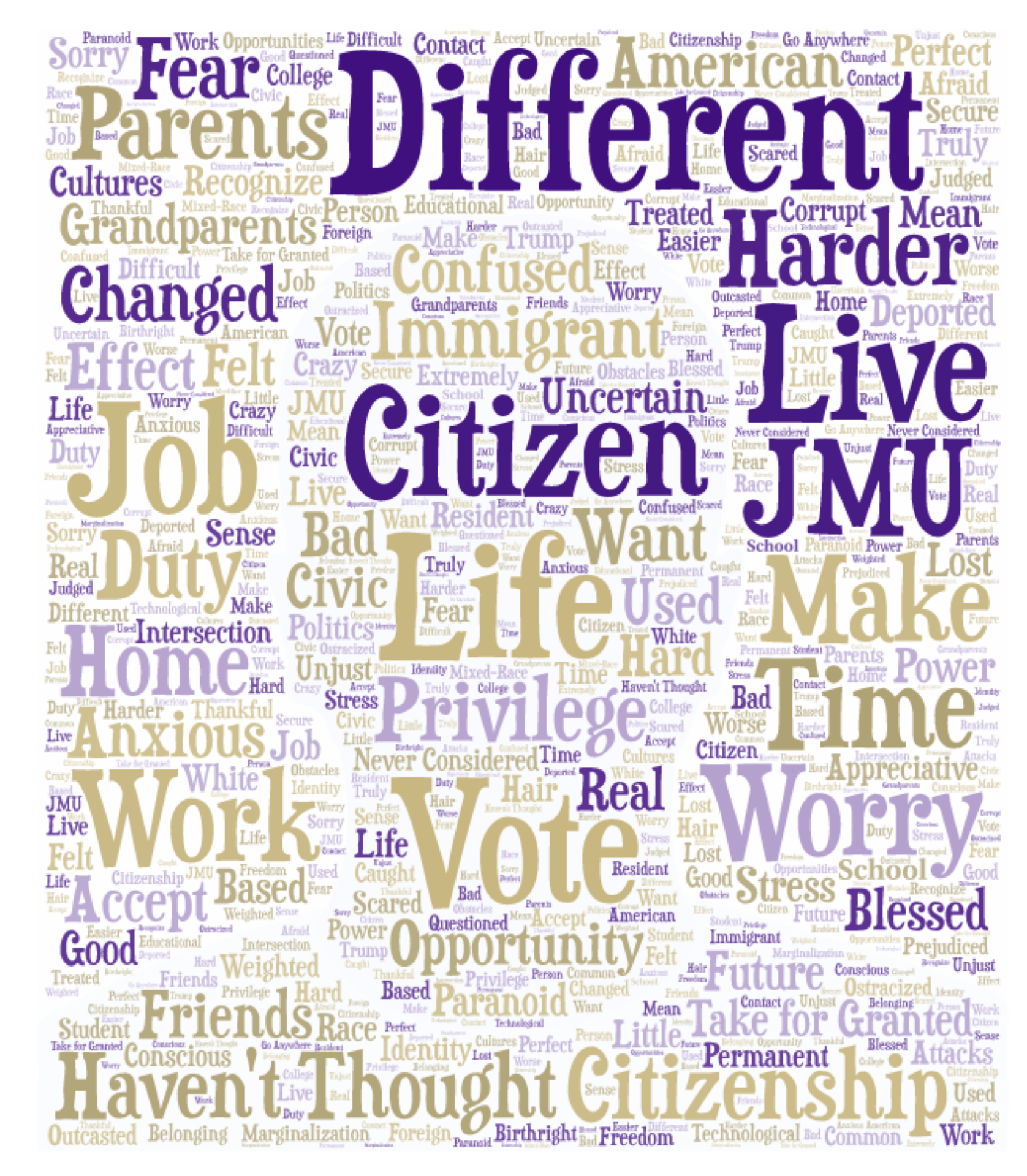
 A delegation of UC San Diego students doing an alternative break on civic engagement with us this week joined us for a Tent Talk on the Quad to learn and talk about immigration. We heard from nearly 100 JMU students who shared their thoughts on the prompts: “Have you thought about your citizenship status today? How would your life be different if your citizenship status changed?” Thanks to the delegation from UC San Diego for helping us facilitate meaningful discussions! Below is the primer on immigration prepared by our undergraduate democracy fellows Angelina Clapp and Mary Tolentino. You can also download the pdf version: Immigration Tent Talk.
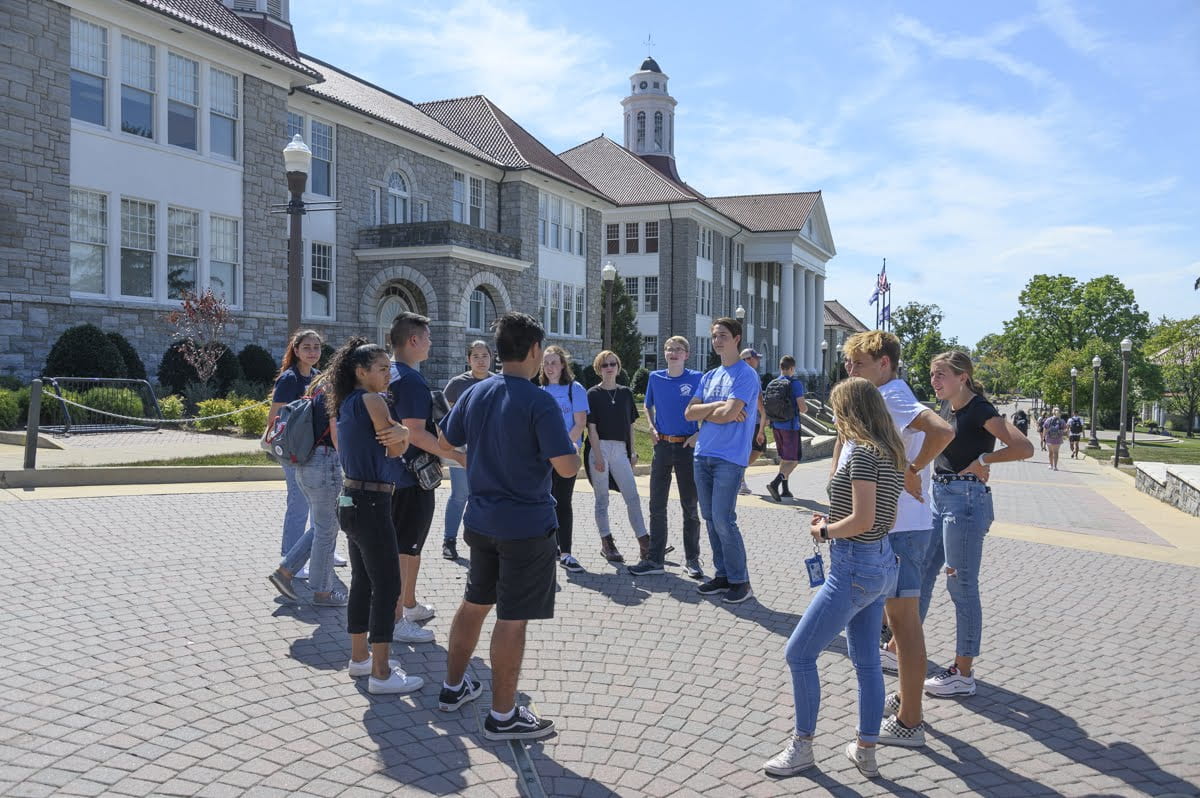

Harrisonburg Community
Harrisonburg, known as the “Friendly City,” is a multicultural, multiethnic and multilingual city that sits in the heart of the Shenandoah Valley in Virginia. Harrisonburg is home to a diverse population of people, including a large immigrant and refugee population, with some 25 percent of the population speaking a language other than English. The proportion of foreign born persons in the area is 16.7 percent, compared to 10 percent in the state of Virginia, and 13.7 percent nationwide.
The Shenandoah Valley’s biodiverse climate has supported a multitude of people groups from hunter-gatherers in the Archaic age to Native American tribes who occupied the area until the early 1700s (Nash, 2016). The first European immigrants to the Shenandoah Valley were German Mennonites and members of Church of the Brethren, whose family farms sustained the local economy until the early 1900s (Zarrugh, 2008). (Brief History of Immigration in Harrisonburg, New Bridges)
In the 1950s and 1960s, the proportion of foreign born persons in Harrisonburg hovered at around one percent. In 1965, the Immigration and Nationality Act repealed immigration quotas based on national origin and made visas accessible to people from all over the world. Mexican migrant workers began to come to the Valley to seasonally to pick apples in the 1970s. Federal policy changes in the 1980s also contributed to the growth of the immigrant community in the area, most notably through the Immigration Reform and Control Act in 1986, which granted amnesty to immigrants who had entered the country without a visa prior to 1982. An estimated 3 million individuals gained legal status through the federal amnesty program, with about 180 in the Harrisonburg area acquiring status with the help of a Spanish-speaking liaison at Blessed Sacrament Catholic Church (Brief History of Immigration in Harrisonburg, New Bridges).
The North American Free Trade Agreement (NAFTA) that was signed in 1992 and implemented in 1994 had negative impact on small Mexican farmers and contributed to the influx of Mexican immigrants to the United States. There were also burgeoning communities of resettled refugees, primarily Kurds and Eastern Europeans, during this time. Labor demands from the poultry industry contributed to an increase in resettlement in Harrisonburg in the 1990s and this growth continues to this day.
Church World Service’s Harrisonburg Immigration and Refugee office has resettled more than 3,500 refugees within 100 mile radius of Harrisonburg since 1988 from: Afghanistan, Azerbaijan, Belarus, Bosnia, Burma, Colombia, Congo (Kinshasa), Croatia, Cuba, Eritrea, Iran, Iraq, Kazakhstan, Kosovo, Russia, Rwanda, Serbia, Sierra Leone, Sudan, Tajikistan, Ukraine, and Uzbekistan. The diverse population in Harrisonburg is also currently reflected in the school system. Thirty-five percent of students enrolled in public school are English Language Learners (ELLs) and 57 languages are represented.
Refugee vs Immigrant
Around the world environmental factors, poverty, food insecurity, violence, conflict and persecution are forcing families to flee their homes in search of safety at an alarming rate. One person is forcibly displaced every two seconds as a result of conflict or persecution. The United Nations estimates there are more than 70 million forcibly displaced persons worldwide, including: 41.3 million internally displaced persons; 25.9 million refugees, over half of whom are under the age of 18, who cannot safely return home; and 3.5 million people seeking asylum.
According to the International Rescue Committee, a refugee is someone who is forced to flee their home country out of fear of the possibility of violence, war or persecution.
-Key words: forced, flee
An immigrant is someone who leaves their country to settle in a foreign country on their own accord.
-Key words: settle, on their own
Local Challenges
Immigrants and refugees in the community face a multitude of challenges, including: tension from the political climate; transportation challenges; better mental health and trauma response; need for bilingual social work practitioners and service providers; need for workplace discrimination legal services; law enforcement; being “welcomed but not included”; and the need for a civic commission to oversee immigration matters.
Harrisonburg ranks 9th among cities in the United States with the highest number of refugees from countries that were on the Trump administration’s travel ban list. There has also been increased Immigration and Customs Enforcement (ICE) presence in Harrisonburg since the 2016 election. Rockingham County Sheriff’s office honors ICE “detainers.” ICE will lodge a detainer against an individual who is incarcerated but about to be released and they suspect of being in the country without authorization. Through the detainer, they ask the jail to continue to hold that person until an agent comes to take them into ICE’s custody.
DACA
Deferred Action for Childhood Arrivals (DACA) is an immigration policy instituted by Executive Order under the Obama administration following the failure of Congress to pass immigration reform. DACA provides a kind of administrative relief from deportation for a certain period of time for youth who immigrated to the U.S. before the age of 16. It also offers work authorization and the ability to apply for a social security number. The Trump administration has sought to end the program.
On June 28, 2019, the U.S. Supreme Court announced that it will grant the Trump administration’s request to review the federal court cases challenging the termination of DACA. For now, the three U.S. district court orders allowing DACA recipients to submit renewal applications remain in effect, and U.S. Citizenship and Immigration Services (USCIS) is still accepting DACA renewal applications from anyone who has previously had DACA.
James Madison University fully supports DACA students and has multiple resources available to students. President Alger recently signed a statement along with 550 other university Presidents in support of the continuation and expansion of the DACA program. JMU’s Center for Global Engagement offers students multiple resources including, free meetings with an immigration attorney, referral to outside counsel for more information, assistance with questions about Social Security Numbers and other legal information.
What can JMU students do to support Harrisonburg’s diverse community?
Students can continue to support JMU’s overall positive support of DACA and support DACA students. Students can volunteer with the multiple organizations in Harrisonburg that work with immigrant and refugee communities. Some of these organizations include:
- Church World Service
- New Bridges
- Skyline Literacy, a local literacy nonprofit, was founded in 1987, and has been an integral part of educating the foreign-born population.
- Virginia Organizing
- Big Brothers Big Sisters Harrisonburg
- A coalition called Friends United for Equity and Grassroots Organizing, or FUEGO, has recently been organizing to oppose ICE – including the move of the agency’s local office to a new facility in May. FUEGO also educates undocumented immigrants about their rights.
Discussion Questions
- How do you think that immigration policy should be reformed?
- What can you do to contribute to addressing immigrant and refugee needs?
- Does anyone who desires to enter the US have the right to do so?
- Should the US limit the number of people allowed to legally immigrate into the country?
- How important is it that immigrants understand the governing principles of the US?
- What are some weaknesses of current immigration policy?
- Do you have any solutions to the current immigration problem?
Resources
Saw this event and really liked it. Really made me think. Being the group back again-our campus needs stuff like this